Ghosting Is Mutual: Ghosted After an Interview?
Ghosted after an interview? Employers and candidates both go silent. Here's why, how long to wait, and how applying earlier to roles you fit can help.
By FastestApplicant · · Updated
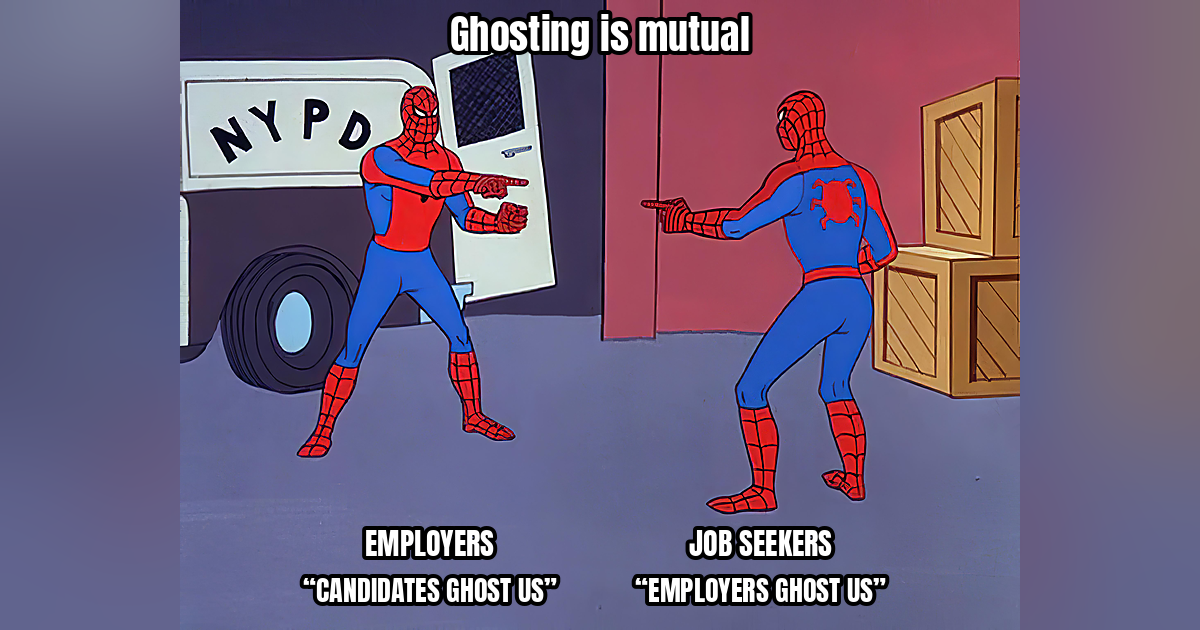
In iHire's 2026 State of Online Recruiting report (a July–August 2026 survey of 1,054 job seekers and 318 employers), 51.6% of employers cited ghosting or unresponsive candidates as a top recruiting challenge. Only "too many unqualified applicants" ranked higher, at 55.7%. On the other side, 57.5% of job seekers said applying and not hearing back from employers, or being "ghosted," is one of their top challenges. It was the #1 response for the third year in a row.
iHire's own summary calls communication "the clearest example of employers and job seekers experiencing the same problem from opposite sides." So if you've been ghosted after an interview, you're not imagining it, and you're definitely not alone. Here's why it happens, how long to wait, when to follow up, and what actually lowers the odds of the silent treatment.
You can't control a recruiter's inbox, but you can reach it earlier, for a role you actually fit. FastestApplicant alerts you when a matching job is posted, so you can apply yourself before the pile builds.
Try FastestApplicant free, no card needed →
Ghosted after an interview? You're in big company
Being ghosted after an interview isn't a fringe experience:
- In Greenhouse's 2024 State of Job Hunting report (2,500 workers across the US, UK and Germany), 61% of job seekers said they'd been ghosted after a job interview, "a nine percentage point increase since April 2024."
- In a May 2026 ResumeBuilder.com survey of 1,000 recent and soon-to-be U.S. college grads, 68% said an employer never got back to them after a job interview.
An interview means someone spent time on you. Silence after that stings more than silence after an application, which is why people search for it after the interview, not after applying.
Candidates ghost employers too
The other Spider-Man has receipts. Besides iHire's 51.6%, SHRM's 2025 Talent Trends research found that 41% of organizations "say they are seeing candidates 'ghosting' the organization during the interview process." iHire also found 20.8% of employers struggle with candidates dropping out of the hiring process or declining offers.
So yes, ghosting is mutual. Candidates skip interviews and stop answering. Employers stop answering too. Each side reads the other's silence as proof that ghosting is normal, and the loop keeps going.
Why do recruiters ghost after an interview?
Mostly, it's volume. Greenhouse customer data from August 2025 showed each role "rising from an average of 28 applications per job in 2021 to 95 in 2025, a 239% increase." Greenhouse puts it bluntly: "With recruiters buried in resumes, communication slips and candidates feel ghosted."
The pile keeps growing. A LinkedIn representative told CNBC in October 2025 that applications on the platform had "surged more than 45% in the past year, with nearly 9,500 applications submitted every minute." In the same article, LinkedIn said 70% of hirers say "less than half the applications meet all the criteria for the role." Greenhouse also reported that 38% of job seekers are mass applying to roles, "flooding employers with resumes rather than pursuing targeted opportunities."
That's the uncomfortable twist: mass applying makes the silence worse. The more low-fit applications pile up, the less time recruiters have to reply to anyone, including the people they interviewed. So when a recruiter ghosts you, it usually isn't personal. It's a team drowning in a queue, a role that got paused, or a decision still stuck with someone else. That doesn't make it OK. It just makes it common.
How long after an interview should you hear back?
There's no universal rule, and no reliable survey gives a single "normal" wait. The best predictor is what the employer tells you, so ask at the end of every interview: "What are the next steps, and when should I expect to hear back?"
Then use this rule of thumb:
- They gave you a date: wait until it passes, plus a couple of business days.
- They didn't give a date: wait about a week before checking in.
- Final round: decisions often need more people to sign off, so a little extra silence is common. It's still fair to ask.
How long it takes to hear back from a job application before any interview is even harder to predict. With 95 applications per job, many applications never get a reply at all. That's one more reason to put your energy into fewer, better-matched applications.
Should you follow up after an interview?
Yes. One short, polite follow-up is normal and won't hurt you. Keep it to a few lines: thank them, say you're still interested, and ask whether there's an update on the timeline. If nothing comes back, one more check-in about a week later is plenty. After that, move on in your head, even if you leave the door open.
What not to do: send daily nudges, guilt-trip the recruiter, or go silent on every other opportunity while you wait.
Ghosted after a final interview: what it usually means
Being ghosted after a final interview hurts the most, because you were so close. Often it means the team picked someone else and nobody closed the loop, or the decision is stuck in approvals, budget or a hiring freeze. Sometimes the role itself was put on hold. You can't tell which from the outside, so send one follow-up, keep applying, and treat any offer that does arrive as a bonus.
2 weeks after an interview and no response?
Two weeks after an interview with no response, and no deadline given? It's time to follow up if you haven't, and time to stop pausing your search. Silence isn't always a no, but it shouldn't freeze you. Keep interviewing elsewhere. If they come back later, you'll have options, and that's a much better place to negotiate from.
How to get ghosted less: apply earlier, to roles you actually fit
You can't control a recruiter's inbox. You can control where you land in it. Recruiters are flooded with low-fit applications, so a strong, early application to a role you actually fit stands out. Here's why applying early matters.
That's what FastestApplicant is built for. It doesn't apply for you, ever. It helps you find the right jobs early:
- Alerts when a match turns up. Job Watchers check public job postings every 15 minutes on the Employee plan (every 30 minutes on the free plan), and each match is sent as soon as a check finds it, by email, Telegram, push, or SMS on Employee.
- JobHeat match score. AI compares each new job with your resume and gives it a match score from 0 to 100%, so you know which to open first. (Employee plan)
- A minimum score. Set a JobHeat minimum from 10% to 75% on a Job Watcher, and jobs below it are logged without sending you an alert. Fewer pings, better fits. (More on AI job matching.)
- Special Instruction Detection. AI pulls out unusual requirements and dealbreakers, like a phrase to include, applying by email, security clearance or in-person interviews for a remote role, so you see them before you apply, not after three rounds. (Employee plan)
You still read the posting, decide, and hit apply yourself. FastestApplicant just makes sure you show up early and qualified.
And when it's your turn to be on the other side of the silence? Don't ghost back. If you've accepted another offer or lost interest, a two-line note to the recruiter keeps your name in good standing. Breaking the loop starts somewhere.
Ghosted after interview FAQ
How long after an interview should I hear back?
It depends on the employer, so ask for the timeline at the end of the interview. If they gave you a date, wait until it passes plus a couple of business days. If they didn't, about a week is a reasonable time to check in.
Should I follow up after an interview if I get no response?
Yes. Send one short, polite follow-up asking about the timeline, and one more about a week later if needed. Then keep your search moving.
Why do recruiters ghost candidates after an interview?
Often it's volume and delays, not you. Greenhouse found applications per job rose from 28 in 2021 to 95 in 2025, and says that "with recruiters buried in resumes, communication slips." Roles also get paused or decisions stall.
Is it normal to hear nothing two weeks after an interview?
It's common, but it isn't a guarantee of a no. If you haven't followed up yet, do it now, and keep applying and interviewing elsewhere.
What should I do if a recruiter ghosts me?
Follow up once or twice, then move on. If there's another contact at the company, such as the hiring manager you met, a single polite note to them is fine. Don't burn the bridge. Roles reopen.
Do candidates ghost employers too?
Yes. In iHire's 2026 survey, 51.6% of employers cited ghosting or unresponsive candidates as a top recruiting challenge, and SHRM found 41% of organizations see candidates ghosting them during the interview process.
Try FastestApplicant free, no card needed →
Sources
- iHire, The State of Online Recruiting 2026 (report): https://www.ihire.com/resourcecenter/employer/pages/the-state-of-online-recruiting-2026
- iHire, 2026 report press release (Sep 22, 2026): https://www.ihire.com/about/press/ihires-2026-state-of-online-recruiting-report-reveals-trust-gap-between-employers-job-seekers
- SHRM, 2025 Talent Trends press release (Jul 25, 2025): https://www.shrm.org/about/press-room/candidate--ghosting--and-employer-competition-are-fueling-talent
- Greenhouse, 2024 State of Job Hunting report: https://www.greenhouse.com/blog/greenhouse-2024-state-of-job-hunting-report
- Greenhouse, Hiring pipeline overload (customer data, Aug 2025): https://www.greenhouse.com/blog/hiring-pipeline-overload
- ResumeBuilder.com, Class of 2026 grads survey (May 2026): https://www.resumebuilder.com/7-in-10-class-of-2026-grads-were-ghosted-after-job-interviews/
- CNBC Make It (Oct 29, 2025): https://www.cnbc.com/make-it/2025/10/29/recruiters-are-drinking-through-a-fire-hose-of-job-applications-experts-say.html