Sent Isn't Seen: Does AI Auto-Apply Actually Work?
AI auto apply tools promise volume, but Indeed bans third-party bots, LinkedIn limits Easy Apply, and hiring software can flag bots. Here's what works.
By FastestApplicant · · Updated
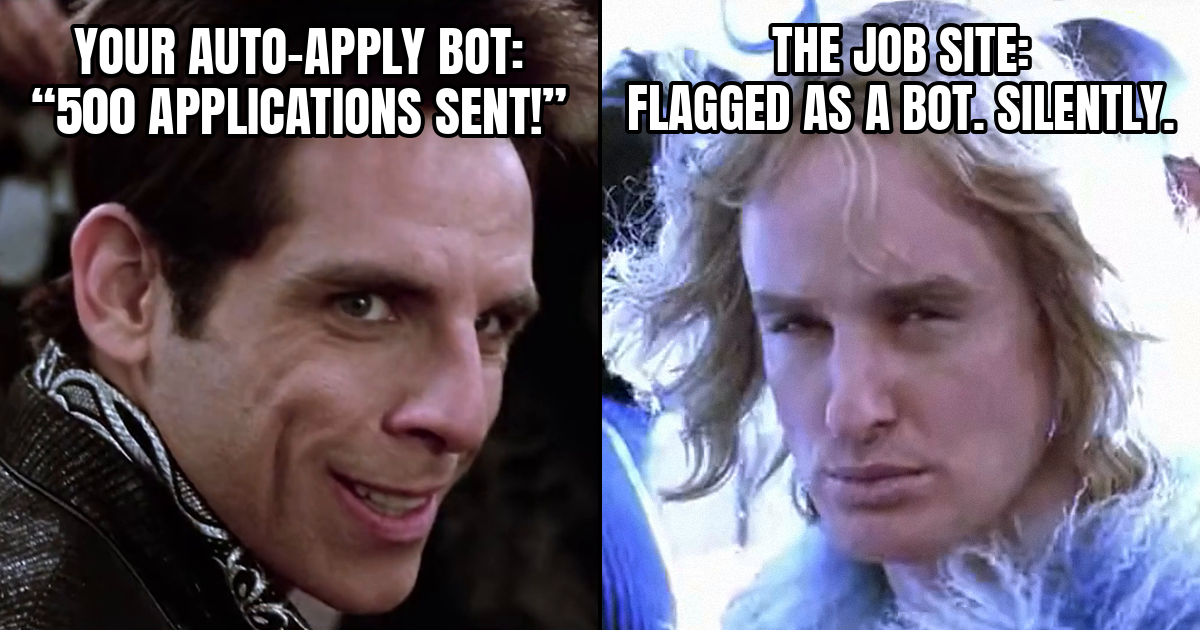
Auto-apply tools promise to take the grind out of the search: give them your resume, and they fill out and submit applications for you, often in bulk. Whether it's sold as AI auto apply or an auto apply AI agent, before you hand your job search to a bot, picture this.
You're hired by a big job site to deal with automated applications. You build a bot detector, switch it on, and start blocking. It works for about a week. Then the bots change how they behave, and your detector stops catching them.
So you build version two, and this time you're smarter about it. You don't tell the bot it was caught. You let the application "go through," show a nice confirmation screen, and quietly flag it as automated on your side. The bot reports success. Nobody upstream has any reason to adapt. And if your terms of service ban automation, you might also restrict the account behind it.
That's a thought experiment, not a description of any one company's system. But many of its building blocks already exist, and they're worth knowing before you point a job application bot at your career.
If you'd rather skip the bot lottery, get alerts for roles you fit and apply yourself. That's what FastestApplicant is for.
Try FastestApplicant free, no card needed →
Is an auto apply bot safe? What Indeed, LinkedIn and hiring software say
Indeed auto apply: the rules on third-party bots
Indeed's job seeker guidelines say: "Don't use third-party bots or other automated tools to apply for jobs." Note the word third-party. Indeed tested its own "Apply For Me" tool in 2026. It paused the automatic mode about a month later and focused on having users review drafted applications before submitting (as reported by Business Insider). Indeed's CEO, Hisayuki Idekoba, framed the goal as: "How can we make sure job seekers are a real person, and it's not an AI application."
Does LinkedIn limit Easy Apply?
Yes. And if you were thinking of a LinkedIn auto apply extension, note that LinkedIn says members who use automation tools "risk having their accounts restricted or shut down." Its Easy Apply has a daily limit that resets at the end of the day (UTC), and a speed limit: "Rapidly submitting applications in a short time triggers a temporary pause on Easy Apply. This helps prevent automation and bots from flooding job postings." LinkedIn also says it "may lower a member's daily Easy Apply limit if we notice activity that seems inauthentic." (If LinkedIn's own alerts are part of the problem, here's an alternative to LinkedIn job alerts.)
How hiring software flags job application bots
Even on company career pages, a bot to apply for jobs meets the employer's applicant tracking system, which checks applications too, often without asking the candidate to do anything:
- Ashby runs online applicants through fraud checks on device, IP, email and phone signals. Ashby says these checks are "designed to be unobtrusive to the candidate experience so as to not require any additional action on their end." Its job-board spam protection "attempts to detect whether a real candidate is submitting the form or if it might be a bot," and the employer sets "the threshold at which Ashby rejects applications."
- Greenhouse lists high-risk fraud signals, "such as the IP address being linked to a data center." Recruiters can tick an "Exclude potential fraud" box in search. Greenhouse is clear that its fraud detection doesn't reject anyone on its own: it "provides a fraud report to employers," and the signals are "specific to your organization." Employers can also set up blocklists that "automatically reject applications" from specific email domains, addresses or IPs.
So "sent" and "seen" aren't the same thing. Your AI auto apply tool can honestly report success, and the application can still land flagged, deprioritized or filtered, depending on how that employer has set things up. You usually won't be told which.
Why job sites are cracking down on auto-apply bots
Volume, and every AI job application adds to it. In October 2025 a LinkedIn representative told CNBC that applications on the platform had "surged more than 45% in the past year, with nearly 9,500 applications submitted every minute." In Greenhouse's 2025 AI in Hiring survey, 34% of U.S. recruiters said they spend up to half their week filtering spam and junk applications. Greenhouse's CEO called it "an AI doom loop": job seekers use AI to apply to more jobs, and employers use AI to filter them back out.
Recruiters notice. Headhunter Nicole Kaiser told CNBC: "we're having the wrong people apply en masse to the wrong roles because of AI." One veteran recruiter who was laid off sent more than 700 Easy Apply applications: "I have not gotten one response back."
Does auto apply work? 3 reasons spray-and-pray backfires
1. Your LinkedIn is the fact-check
In a January 2024 ResumeTemplates survey of 781 U.S. hiring managers, 18% said they always check a candidate's LinkedIn, 31% often and 29% sometimes. Of those who look, 65% said it's very or somewhat common for the profile not to match the resume. ResumeTemplates' career coach Andrew Stoner put it plainly: "employers, dates, and titles should all match precisely." An AI that rewrites your resume for every job can drift from the one profile you can't rewrite 500 times. Tailor what you emphasize. Keep the facts identical.
2. Fit beats volume
In Huntr's tracking data (October 2024 to June 2026, about 2 million applications), applications with a tailored resume were marked interviewed 5.71% of the time, against 3.09% without one. Huntr warns these are "descriptive associations, not causal estimates," but the direction matches what Kaiser told CNBC: put an AI-submitted application up against someone who matched their resume to the job description, and "more than likely that person's going to get the phone call." Speed helps too, as long as the application is real. Here's why applying first matters.
3. The dealbreaker is in the fine print
A job can look perfect until line 40: a security clearance, a citizenship requirement, an on-call rotation with nights and weekends, or an "in-person final interview" for a remote role. A bot that never reads the posting applies anyway. You find out after three rounds of interviews.
Looking for an AI auto apply tool? Here's the honest answer
If you searched for a tool that applies for you, we're not it, and we'd rather say so up front. FastestApplicant sends fast alerts when new jobs match what you want. It never auto-applies, never submits applications and never logs in to your job-site accounts. You still click "apply" yourself.
The alternative: apply first, and apply yourself
FastestApplicant is an auto apply jobs alternative. It does the prep so you can apply yourself, early:
- Fast alerts. Job Watchers check public job postings every 15 minutes (every 30 on the free plan) and send alerts by email, Telegram, push or SMS.
- JobHeat match score. AI compares your resume to each job description, and the JobHeat filter skips alerts below the score you choose. (Employee plan)
- Special instructions and conditions flagged up front. Things like security clearance, citizenship requirements, on-call or unusual hours, in-person interviews for remote roles, application fees, AI interviews, or a phrase you're asked to include. (Employee plan)
- A cover letter for each job. A short cover letter written for each match from your resume, ready to edit and send. (Employee plan)
AI does the prep. You make the call.
Auto-apply FAQ
Is auto apply safe?
It depends on the tool and the site, but the risk is real. Indeed's guidelines prohibit third-party bots for applying. LinkedIn says automation tools violate its User Agreement and can get accounts "restricted or shut down." Employer systems like Ashby and Greenhouse can flag suspicious applications. See how FastestApplicant differs from auto-apply tools.
Does AI auto apply actually work?
It sends applications. Whether anyone reads them is another matter. Recruiters report floods of low-fit applications, and tailored applications show higher interview rates in Huntr's data (5.71% vs 3.09%, an association, not proof of cause). Fewer, better-fit, earlier applications are the safer bet.
What is the LinkedIn Easy Apply limit per day?
LinkedIn doesn't publish the number. Its Help Center says there's a daily limit that resets at the end of the day (UTC), a speed limit that pauses Easy Apply if you submit rapidly, and a lower limit for accounts whose activity "seems inauthentic." Figures you see online come from third parties, not LinkedIn.
Can LinkedIn or Indeed restrict your account for using an auto apply bot?
LinkedIn says members using prohibited automation "risk having their accounts restricted or shut down." Indeed's guidelines say not to use third-party bots or other automated tools to apply. Restrictions apply to your account on that platform. There's no evidence of one shared blacklist across all job sites.
Can employers tell an application was sent by a bot?
Sometimes. ATS tools look at signals such as device, IP address, email and phone. Greenhouse, for example, treats an IP address linked to a data center as a high-risk signal. What happens next is up to each employer: review, deprioritize, filter or reject.
Try FastestApplicant free, no card needed →
Sources
- Indeed Job Seeker Guidelines
- Business Insider, "Indeed's CEO wants to break this 'vicious cycle' in hiring" (Sep 12, 2026)
- LinkedIn Help, Prohibited software and extensions
- LinkedIn Help, Easy Apply limits
- Ashby, Fraudulent Candidate Detection (Sep 16, 2025)
- Ashby, Job Board Application Spam Protection
- Greenhouse Support, Fraud Detection
- Greenhouse Support, Fraud Detection and Spam Blocklist FAQ
- Greenhouse 2025 AI in Hiring Report (press release, Nov 19, 2025)
- CNBC Make It (Oct 29, 2025)
- ResumeTemplates hiring manager survey (Jan 2024)
- Huntr Q2 2026 Job Search Trends Report